
AI Idea Scoring   ◉   Idea Management Software   ◉   Ezassi

Every Idea Scored. Every Submission Reviewed. No Backlog.

When an innovation challenge generates 50, 100, or 500 idea submissions, the review bottleneck quickly becomes the program’s biggest hurdle. Soon, reviewers get fatigued. Consequently, scoring drifts. Meanwhile, good ideas wait months to be evaluated — and by the time they are, the window has often closed.

To solve this, Ezassi’s AI Autoscoring reviews every submission against your rubric the moment an idea is submitted — scoring each criterion, providing a written rationale for each score, and presenting the results alongside your human reviewers in a single comparison view. In short, no backlog, no inconsistency, and no ideas that fall through the cracks.

AI-Powered Ideation That Works While You Don't

The Idea Is Not the Problem. The Review Process Is.

In fact, most innovation programs do not fail at ideation — they fail at evaluation. Specifically, the same three problems repeat across every organization that runs challenges at scale.

Review Fatigue

Asking the same reviewers to evaluate dozens or hundreds of submissions produces diminishing quality. As a result, the fiftieth idea gets a fraction of the attention the first one received.

Scoring Inconsistency

Similarly, two reviewers applying the same rubric rarely produce the same score. However, without a consistent baseline, comparing ideas across reviewers or challenge cycles becomes impossible.

Delayed Decisions

Ideas that wait weeks or months for review lose momentum. Consequently, submitters disengage, program credibility erodes, and the next challenge attracts fewer submissions.

Configured to Your Rubric. Applied to Every Submission.

Indeed, AI Autoscoring is not a generic scoring algorithm. Instead, your team configures it to your organization’s specific evaluation criteria, and it applies those criteria consistently to every idea that enters the platform.

Illustration of a smiling person holding a tablet in front of a large digital screen displaying charts. Icons of time, money, and ideas surround them.

Step 1

Configure Your Rubric

To begin, work with your Ezassi setup team to define the scoring criteria that matter to your organization: Strategic Fit, Problem Worth Solving, Size of Prize, Technical Feasibility, or any custom dimensions. This step also includes setting the weighting and scale for each criterion.

Step 2

Submission Triggers Scoring

When an idea is submitted to a challenge, AI Autoscoring activates immediately. Then, the AI evaluates the submission against each rubric criterion, assigns a score, and generates a written opinion explaining its reasoning.

Step 3

Results Appear in the Review View

The AI score and written opinion then appear in the Review Form Results alongside your assigned human reviewers. In addition, program managers can see all scores in a single comparison view, and the platform calculates total scores automatically.

Importantly, AI Autoscoring does not replace your human reviewers. Instead, it ensures every submission carries a consistent, reasoned baseline score before human review begins — so reviewers spend their attention on evaluation and discussion, not initial triage.

Not Just a Score. A Scored Opinion.

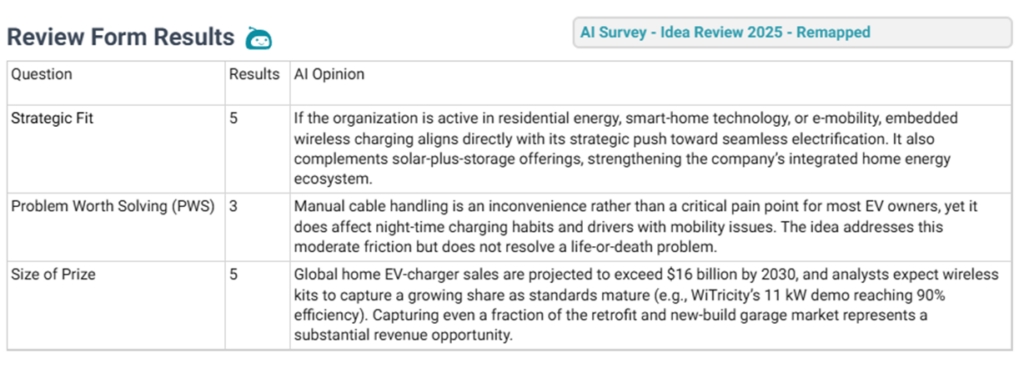
Whereas most automated scoring tools return only a number. Ezassi’s AI Autoscoring, by contrast, returns both a number and a written rationale — a paragraph explaining exactly why the idea received the score it did against each criterion. In practice, that rationale proves immediately useful to reviewers, program managers, and idea submitters who want to understand the feedback.

Rubric Criterion

AI Score

AI Opinion

Strategic Fit

5 / 5

If the organization is active in residential energy, smart-home technology, or e-mobility, embedded wireless charging aligns directly with its strategic push toward seamless electrification. It also complements solar-plus-storage offerings, strengthening the company’s integrated home energy ecosystem.

Problem Worth Solving

3 / 5

Manual cable handling is an inconvenience rather than a critical pain point for most EV owners, yet it does affect night-time charging habits and drivers with mobility issues. The idea addresses this moderate friction but does not resolve a life-or-death problem.

Size of Prize

5 / 5

Global home EV-charger sales are projected to exceed $16 billion by 2030, and analysts expect wireless kits to capture a growing share as standards mature. Capturing even a fraction of the retrofit and new-build garage market represents a substantial revenue opportunity.

Notably, the platform generates each written opinion from the idea submission itself — not from a template. Therefore, each score reflects the AI’s evaluation of that specific submission against that specific criterion, based on your rubric and context.

One View. Every Reviewer. Including the AI.

Together, the Review Form Results view shows every reviewer’s scores in a single comparison table — human reviewers and the AI Review column side by side. As a result, program managers can see immediately where scores align and where they diverge, without pulling data from separate systems or waiting for reviewer submissions to consolidate.

CriterionReviewer 1Reviewer 2AI ReviewTotal Score
Strategic FitAverageAverageHigh
Score Expression15155
Problem Worth SolvingLowLowHigh
Score Expression555
Size of PrizeLowAverageAverage
Score Expression395
Total Score232915

In this example, the AI score surfaces a higher Strategic Fit assessment than either human reviewer — and the written opinion explains why. Specifically, that divergence is valuable: it prompts a more deliberate discussion about strategic alignment rather than letting a consensus score pass without scrutiny.

Your Rubric. Your Criteria. Your Scale.

Overall, AI Autoscoring uses your evaluation framework instead of a generic template. Here is what your team controls.

Scoring Criteria

First, define the criteria the AI evaluates against — Strategic Fit, Problem Worth Solving, Size of Prize, Technical Feasibility, Market Readiness, or any custom dimensions specific to your innovation program.

Score Scale and Weighting

Next, define the criteria the AI evaluates against — Strategic Fit, Problem Worth Solving, Size of Prize, Technical Feasibility, Market Readiness, or any custom dimensions specific to your innovation program.

Context and Framing

From there, provide the AI with the challenge context — the problem statement, the strategic objective, the target technology area. Naturally, the more context the AI receives, the more specific and useful its scoring rationale will be.

Challenge-Level Configuration

Finally, Ezassi configures AI Autoscoring per challenge, not once for the whole platform. Consequently, a product innovation challenge and an operational efficiency challenge can use completely different rubrics, scales, and contexts.

Scoring Is the Beginning, Not the End.

Beyond scoring, AI Autoscoring is one feature inside Ezassi’s full Idea Management platform. Once ideas are scored — by AI, by human reviewers, or both — they flow directly into the pipeline. From there, program managers can sort and filter by total score, by criterion, or by reviewer. For example, high-scoring ideas advance to the next workflow stage with a single action, while program managers can decline low-scoring ideas with an explanation drawn directly from the AI’s rubric assessment.

Better still, there is no need to export data to a spreadsheet or an email chain. Instead, the platform centralizes the full submission, the AI score and opinion, the human reviewer scores, and the stage-gate decision. Additionally, any authorized team member can access a complete, time-stamped audit trail for each idea.

What Changes When Every Idea Gets Reviewed Immediately.

Zero Backlog

Specifically, AI Autoscoring activates on submission. Consequently, by the time a human reviewer opens the review queue, every idea already carries a scored baseline — and the backlog never accumulates.

Consistent Baseline

Critically, the AI applies the same rubric criteria, the same context, and the same scale to every submission. Therefore, drift between reviewers and across challenge cycles becomes measurable and discussable rather than invisible.

Better Human Review

As a result, reviewers who start from a scored baseline — with a written explanation already present — spend their time on judgment and discussion rather than initial triage. In turn, review quality goes up as review time goes down.

Request a Demo

See AI Autoscoring Applied to Your Innovation Challenge.

A man in a suit uses virtual reality gear, immersed in a high-tech office with computer monitors. The atmosphere is modern and innovative.

The best way to evaluate AI Autoscoring is to see it run against a real challenge rubric. So, in a 30-minute demo we will show you the comparison view with a sample submission, and answer your questions about setup, configuration, and integration with your existing review process.

Scroll to Top