Regulatory Monitoring ◉ Ezassi Watch
Regulatory Monitoring Software for Whoever Gets the First Call.
One complete regulatory watch, in the open.
Monitoring is easy to claim and almost impossible to check from the outside. So here is a whole one — the standing watch on US food safety regulation, exactly as it is delivered. Not an extract and not a sample chapter.
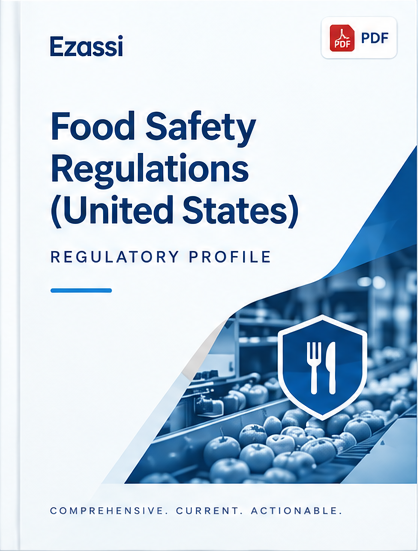
Food Safety Regulations (United States) — Regulatory Profile
• Six governing bodies, from FDA and USDA FSIS down to state departments of agriculture and local health
• Every regulation in force, each with its jurisdiction, status, effective date, scope, core requirements and penalties
• The compliance gates — what has to be in place before you operate, and what has to be on the label
• A decision playbook written separately for compliance, supply chain, legal, manufacturing and the executive team
• Every source listed — and the facts drawn from model training marked as such, rather than mixed in
Get the complete watch
The Role Nobody Budgeted For.
The obligation attaches to you, not to the brand
A contract manufacturer making product for forty brands carries forty brands' worth of exposure, because the rule attaches to the facility rather than the label. Their compliance department is not your compliance department, and their auditor's questions arrive at your door.
Rules rarely change in one place first
A bill moves through committee. A docket fills with comment. An enforcement pattern forms. A standards body revises. By the time the rule itself changes, it has usually been visible in four other places for a year.
The late version is the expensive version
A requirement that takes effect in January was proposed eighteen months earlier. Learning about it then is a project. Learning about it from a customer's questionnaire, an auditor, or a detention notice is something else.
We Don't Write Regulatory Reports. We Run Standing Watches on Named Categories.
A regulatory watch is built once for a named category — US food safety, EU battery materials, UK medical devices — and then it runs. It covers the authorities, the subtopics, the stated exclusions and the stated coverage limits, and every finding is dated and cited to the record that produced it.
The watch is shared
Your exposure is yours
TEAL TREATMENT
A consultant starts from zero on the day you hire them. A watch that has been running has a history — of what changed, when it changed, and what was known at the time. That history is the thing you cannot commission after the fact, and it is the reason the second year costs less than the first rather than the same.
Name a Subject and a Jurisdiction. That Is the Whole Requirement.
ALL OF THESE WORK
- EU AI Act compliance for medical device makers
- US food safety regulations under FSMA
- UK medical device regulation post-Brexit (UKCA marking)
- Data privacy rules for health apps in the EU under GDPR
- FDA requirements for AI-based diagnostic software in the United States
- Battery materials and recycling regulations across the EU
- Pet food labelling rules in the United States (AAFCO/FDA)
THESE DON'T
“AI regulations.”
“Medical device compliance.”
“Food safety rules.”
A subject with no place attached — and the same three words mean different obligations in Brussels than they do in Bethesda.
THESE DON'T
“AI regulations.” “Medical device compliance.” “Food safety rules.” A subject with no place attached — and the same three words mean different obligations in Brussels than they do in Bethesda.
Intake is two steps and the first one asks for a name and a website.
About 15 to 30 minutes later the watch is live. No implementation project, no consultant, no scoping phase.
A Standing Profile, a Rated Signal Stream, and a Report That Ends in Deadlines.
The Profile — what the rules are, right now
The standing dossier for your category: the governing bodies, every regulation in force with its scope and its penalties, the compliance requirements, the recent developments, and a strategic assessment of where the burden actually falls. It is what you hand a new hire on their first day, and it does not go stale on the shelf, because the watch keeps it current.
The Signals — what is moving, and how much to trust it
What is changing before it has changed. Each signal carries the call, the reasoning behind it, the dated pattern of events that produced it, what it implies for your own portfolio, and a recommended action. Each is rated for confidence and for time horizon, so a thin early rumour and a converging multi-source pattern do not arrive looking the same.
The Record — what changed, and what do I have to do now?
Reads the official record directly: the Federal Register, enforcement and recall databases, import alerts, inspection and safety notices. Every change is dated, rated for impact, mapped to the regulation areas it touches, and cited to the primary source by number. It ends in an action list ordered by deadline — and it is built to hold up six months later, when somebody asks why a decision was made the way it was.
Every Claim Is Checked Against the Primary Record. So Is Everything That Didn't Hold Up.
The list of what we could not confirm ships with the report. That is the part you do not get from a system that is confident by default.
What one monthly cycle actually looked like
On a single category watch in May 2026: more than forty regulatory occurrences in the month, synthesised into eight signals rather than forty alerts. Twenty-eight corrections applied during fact-checking against primary sources. Five claims that could not be corroborated, marked Inconclusive and listed on the first page rather than buried.
The Rule Is the Last Place It Shows Up.
Legislative and statutory activity
Bills moving through committee, and the ones that keep being reintroduced.
Regulatory agency actions
Proposed rules, final rules, guidance, and the dockets where comment volume says how contested something is.
Enforcement and compliance patterns
What is actually being cited, detained and recalled — which moves before policy does.
Judicial and legal precedent
Court reasoning that changes how much deference an agency's own reading gets.
Standards bodies and industry self-regulation
The revisions that become the reference before they become the requirement.
WORKED EXAMPLES
What This Costs Compared With What You Are Doing Now.
What it is | What it costs | What it gets you |
Nothing | $0 | Somebody’s evenings, and the risk that the first notice is a detention. |
Page-change monitoring | Low hundreds a year | An alert when a web page changes. No reading, no judgement, no deadline. |
Per-document review | Per label, per filing | An answer to the question you already knew to ask. |
An outsourced retainer | Tens of thousands a year | Expertise that starts from zero each engagement and leaves when the contract does. |
One in-house regulatory hire | Six figures, fully loaded | Everything above, for one jurisdiction, until they take another job. |
The Official Record, Read Directly.
A regulatory watch reads the record itself rather than coverage of it: the Federal Register, agency enforcement and recall databases, import alerts, inspection and safety notices, agency dockets and the comment volume they attract, court filings, and standards-body publications. Where a watch covers a jurisdiction outside the United States, it reads that jurisdiction's equivalents.
Tell Us What You Make and Where You Sell It. We'll Build the Watch Live.

In thirty minutes we’ll stand up a watch on your own category and jurisdiction, show you what a rated signal looks like when it fires, and walk the path from a change in the record to an action with a date and an owner. No generic walkthrough — we work from your products, not our examples.