Insight Is Everywhere. Action Is Not.
Most consumer product firms are not short on research. They hold buyer insights, market data, test results, and trend reports. Still, many of these same firms struggle to launch winning products. They also move too slowly on new ideas. The problem is rarely a lack of insight. Instead, it is the lack of a scalable innovation research system that turns insight into action.
A scalable innovation research system links your research to your choices. It runs as an ongoing habit, not a string of one-off projects. As a result, your team acts on fresh facts, not last quarter’s report. This post explains what the system looks like. In addition, it shows how to build one.
Why Most Innovation Research Fails to Scale
Traditional innovation research works as a set of loose, stray tasks. Teams order one-off studies, buy outside reports, and run lone test cycles. Of course, each effort has value on its own. Together, though, they rarely add up to a system.
Here is why these efforts fail to scale. They are siloed, because each team runs its own study. They are episodic, since insight lands at set points, not all the time. They are static, so the output sits in a slide deck and then in a folder. Worst of all, they are cut off from action. The research seldom links to the pipeline.
The result is familiar. Insight piles up, yet impact does not follow. Choices still wait on the next study. Meanwhile, faster rivals move first.
Research from McKinsey backs this up. Firms that master several of the eight essentials of innovation tend to beat their peers. Notably, scale and repeat use sit among those essentials.
What a Scalable Innovation Research System Looks Like
A scalable innovation research system turns research from a project into a skill. Rather than churning out reports, it gives you intel you can act on. At its core, it links four parts.
Always-On Data and Insight Inputs
First, the system pulls from many streams at once. It reads buyer behavior, market trends, rival moves, product results, and new tech. AI helps it sort large data sets and spot patterns fast. Therefore, your choices rest on fresh facts, not stale ones.
Ezassi gathers these signals through Agentic Innovation Monitoring. The feature tracks rivals and R&D moves on an ongoing basis. In short, the research never stops between projects.
One Joined-Up Intelligence Layer
Next, the system joins what would stay split. After all, most firms own plenty of data. Few link it well. A strong layer blends inside sources, outside research, and expert reading. As a result, your team sees one clear view of the field, not ten partial ones.
This is where breadth pays off. The 3DScout Library holds primary-source records across many data domains. By drawing on many domains at once, you gain insight that any single source would miss.

Clear Scoring Frameworks
Insight alone does not drive choices. For that reason, top teams score each option against clear tests. These tests cover market pull, build effort, fit with strategy, and sales upside.
In particular, two scores help most here. Technology Readiness Level, or TRL, shows how ripe a technology is. Commercial Readiness Level, or CRL, shows how close it is to market. Together, TRL and CRL turn raw insight into ranked, like-for-like options. Without this layer, even strong research can stall.
Built-In Decision Workflows
Finally, the system links insight straight to action. It feeds the pipeline, the roadmap, and your spend choices. As a result, every insight has an owner. Every option has a next step. Every choice leaves a trail you can trace later.
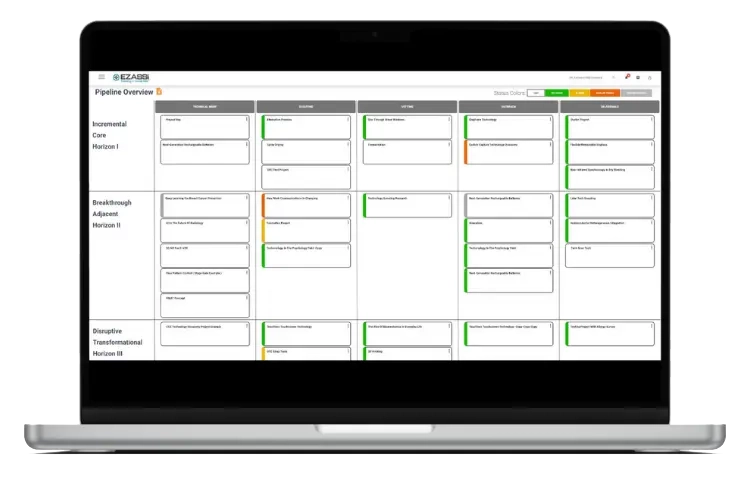
Ezassi handles this stage with pipeline management software. Your team can send any find straight to a pipeline project. In this way, research and action share one home.
How Leading Firms Are Making the Shift
Forward-looking firms are changing how they treat research. The old model ran in three steps. Teams would order a study, get a report, and make one stray choice. The new model runs as a loop instead.
In the new model, teams gather signals all the time. Then they blend and read those signals in near real time. From there, they make clear, repeatable choices. This shift mirrors a wider move toward data-driven decisions.
The proof is strong. According to Harvard Business School research, data-led firms report far better choices than their slower peers. Likewise, HBR has shown how this way of working keeps spreading. Speed and follow-through are the payoff.
The Benefits of a Scalable Innovation Research System
When you do this well, the gains are real and clear. Choices come faster, because fresh insight ends the wait for new research. Pipelines grow stronger, since scoring moves only the best options ahead. Rework drops, because you capture insight once and reuse it. Return on innovation climbs, since each choice stays ranked and tied to the plan. Teams line up better, too, since they share one view of the market.
Above all, the system compounds over time. Each project adds to a shared base of know-how. You no longer start from zero.
Where Most Firms Get Stuck
Many leaders see the need to change. Even so, they struggle to put a system in place. A few barriers come up again and again.
Teams often sit in silos. Research, innovation, and strategy each work alone. Old processes add drag, too, since they were built for slower times. On top of that, most firms lack a shared way to score options. Finally, tool overload is common. Many tools exist, yet none link into one system.
The Role of AI and Expert Judgment
A strong system needs two things working as one. It needs tech to sort data, spot patterns, and run routine analysis. It also needs people to read context, check findings, and guide strategy.
The best approach is AI + Human in the Loop. AI brings scale and speed. Meanwhile, experts bring judgment and care. You can see this model in Ezassi’s open innovation research services, where analysts check machine-made findings. As a result, you get both reach and trust.
What This Means for Innovation Leaders
For R&D leaders, the question is changing. The old question was simple. They asked what research they needed next. The better question is bigger. They now ask how to build a system that turns insight into action again and again.
To get there, you join up your research. You set one shared way to score options. Then you build insight right into your workflows. Firms that do this well tend to beat rivals, lower risk, and ship new products faster.
From One-Off Research to Repeatable Skill
Building a scalable innovation research system is not about doing more research. Rather, it is about making your research work harder across the firm. The winners are not the firms with the most data. They are the ones that link insight, act with nerve, and refine each choice over time.
In this model, innovation stops being a string of stray efforts. Instead, it becomes a steady skill that compounds. That is the real payoff of a scalable innovation research system.
Is your team running study after study with no shared learning? Are you struggling to link insight to action? If so, it may be time to rethink your model. Book a discovery call to see how ongoing, expert-led intel can turn loose research into a system that delivers.